Questions, answered.
All the questions from all eRotor pages, grouped. If yours is not here, write to us.
Everything partners ask.
Short, factual answers; the details are on the eRotor, Integration and How to buy pages.
Product
How do I choose between the five sizes?
By the area you need to cover and the local rules for warning. 500 W — two amplifiers, four horns, 115 dB(A) at 30 m — is what most partners order. 250 W covers a small site with two horns; 1,500 W with twelve horns and four amplifiers reaches 121 dB(A) for wide, open areas. Send us the site and we recommend a configuration.
How were the acoustic figures measured?
Two ways. The acoustic report measures each of the 13 configurations at 30 m in 24 directions at 15° steps, as LpAeq in dB(A), and gives the median, average, maximum and minimum for every type. The 2–3 dB(A) advantage comes from certified comparative measurements against comparable sirens at the same distance.
What is the basis of the “500 W sounds like 1,200 W” claim?
The datasheet compares the acoustic pressure at 30 m: a 500 W eRotor and a common 1,200 W electronic siren both give 115 dB(A). The reasons are the signal processor, the separated power supply and the thick aluminium horns.
How long does eRotor run without mains?
At least 15 minutes of alarm and at least 72 hours without mains, and more than a week on standby, from two 12 V batteries of 24–65 Ah. The batteries are charged continuously from mains or from a solar panel the customer connects.
How many horns can one amplifier drive?
Up to four. A 500 W siren runs four horns from two amplifiers; the same two amplifiers can also drive six horns, three per side, as in the 750 W size. From 1,000 W upwards the siren uses four amplifiers.
Does the siren work without batteries?
No. eRotor always runs from its two 12 V batteries; mains or solar power only charges them. That is why a grid failure does not stop the siren.
Where is the cabinet installed?
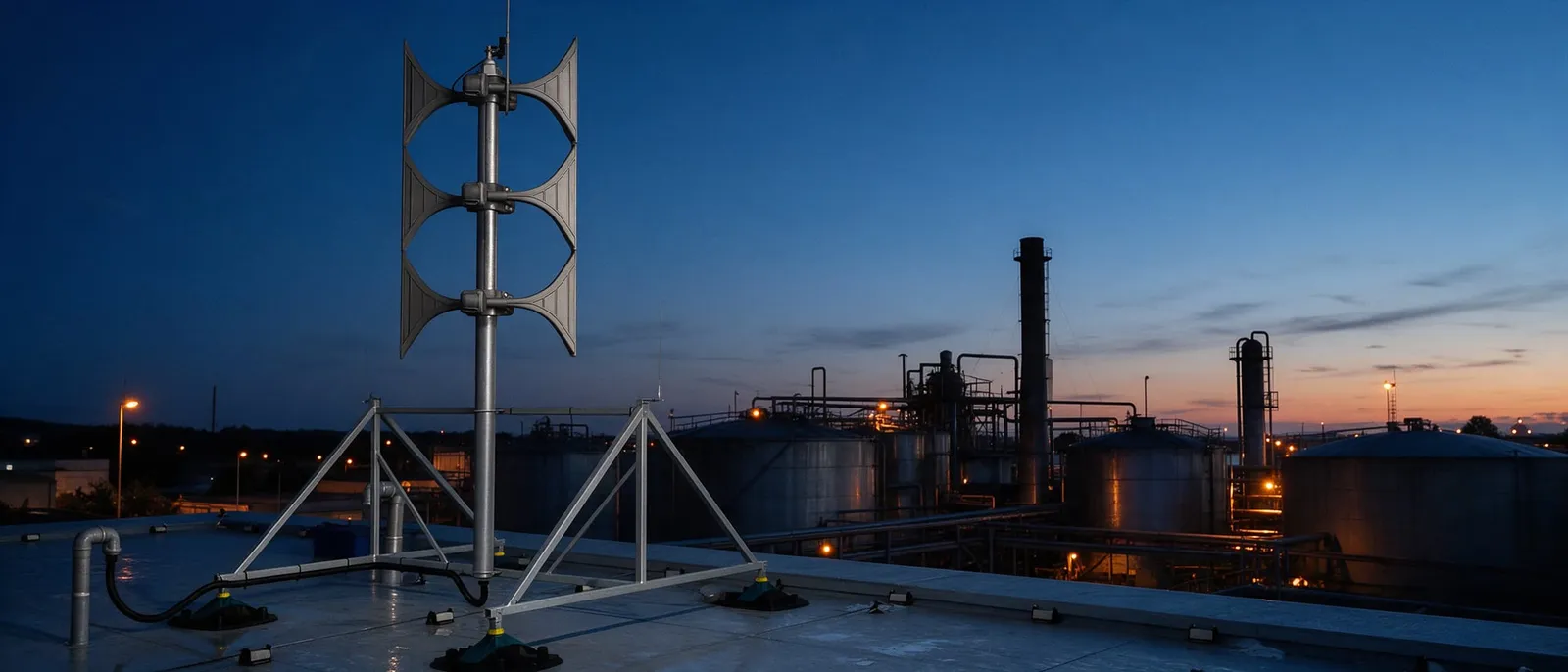
Indoors or in a protected enclosure, out of direct sun; only the horns go outside on the mast. If a site needs heating or cooling for the cabinet, the local partner arranges it as part of the installation. The cast aluminium horns withstand heat, frost and salt air.
Which certification does eRotor have, and who handles local approval?
eRotor is CE certified. Certification required by national rules in your country is arranged by the local partner, who knows the procedure and the authorities.
Which tones and voice messages can it play?
Alarm tones are customisable and stored on an MMC memory card in the control unit. Recorded voice messages are uploaded with the Windows configuration software over RS-232, and an AUX input takes live or external audio.
What is in the two public PDFs?
The datasheet: the five sizes with sound level at 30 m, horns, amplifiers, weights and dimensions, power supply and batteries, control inputs and self-test. The acoustic report: 13 configurations with nominal level, horns, batteries, mast length and horn weight, plus a direction chart with 24 measured values for each.
Integration
Is a control centre or network software included?
No. Tausec sells sirens and modules, not control systems. The configuration software works with one siren at a time over RS-232; the dispatch centre and the control of many sirens are part of your system.
Can the siren be controlled over IP?
Not directly — the cabinet has two binary inputs, RS-232 and CAN bus, with radio control, POCSAG, RDS and GSM as options. For IP you add a converter module between your network and the RS-232 port; the siren electronics stay unchanged.
Is the RS-232 protocol documented?
Yes, and it is open: it can be adjusted to the requirements of your project. The link is two-way — your system sends commands and receives feedback about the siren’s function. Ask for the description together with your project details.
How do I control many sirens at once?
From your own control system. Each eRotor is one endpoint with its own inputs; which sirens sound, when and with which tone is decided by your logic and carried by your network — radio, relay lines or IP via converter.
Which input do most projects use?
The binary input — a relay contact from a sensor, a safety system or an operator’s switch. The datasheet calls it the primary control; RS-232 is for more complex applications, and the keypad with LCD is the backup for trained personnel.
Can water-level sensors trigger the siren directly?
Yes, through the binary input. That is how the ≈250 sirens of the flood-warning project in Malaysia are triggered; the sensor logic and thresholds belong to the partner’s system.
Who installs the siren, and how long does it take?
The local partner. The cabinet goes on a wall and the horns on a 114 mm steel mast prepared by the customer, usually on a roof; cabling, configuration and the self-test follow. Typically one working day when the site is ready.
What documentation do partners get?
Technical information, installation instructions, the Windows configuration software and technical support from the engineers who designed the siren. A new partner also receives the price list for modules and complete sirens.
Buying
Do you sell to end customers?
No. eRotor is sold only through local partners — system integrators who win projects by tender, direct negotiation or referral in their country. The partner installs, certifies and services the sirens and stays the supplier in front of the customer.
Are there public prices?
No. New partners receive a price list with prices for complete sirens, the Siren Kit and individual modules, so you can compare buying complete with assembling yourself. Write to us with the application and quantity.
What is in the Siren Kit, and can I sell it afterwards?
A working 250 W siren: control unit, two amplifiers, two drivers and two horns, wired with plug connectors so your technicians can take the modules apart and put them together again. Afterwards you can sell it as a finished siren.
What does the warranty cover?
Warranty service and replacement of modules: a faulty module is replaced, not the siren. Ask for the warranty terms together with the price list.
Can we assemble the sirens ourselves and offer them as our own product?
Yes. Once your team knows the platform, you order only the modules you need, assemble sirens in your own workshop and offer them as your own solution. You keep control of the system, the service and the margin.
What are the lead times?
Modules in stock are configured and shipped within about a week. Built to order takes up to four weeks; production starts after the order is clarified and paid in advance.
What do new partners usually order first?
Most start with complete sirens or the Siren Kit, learn the platform on real hardware and move to modules later. Nothing obliges you to follow that sequence.
How do you ship?
Modules and small numbers of sirens go by air, about a week. Larger orders go by sea, one to two months — the cast aluminium horns are the heavy part, 27 to 165 kg per siren with drivers.
Why are the installation instructions and the software not public?
They are part of what partners receive with their first order, together with the price list and technical support. Write to us with your project and we send them.
References
In which countries is eRotor installed?
Through local partners in several countries, mostly outside the EU. We do not publish the list; the one project we describe is the government flood-warning project in Malaysia.
Have the sirens been used in real events?
Yes. In Malaysia, eRotor sirens triggered by water-level sensors have warned people in the area and helped with evacuations. The project is ongoing.
Who installs and operates the sirens in a project?
The local partner. Tausec supplies the sirens, modules, documentation and know-how; the partner designs the control system, installs, certifies and services the sirens and runs them for the customer.
Can we see an installation or talk to a reference?
Installations are run by local partners and their customers, so a visit or a reference contact goes through them. Write to us with your project and we will see what the partner can arrange.
Who are your customers?
Governments, civil protection agencies, industrial operators and defence forces — always through the system integrator who delivers the project locally. The applications are natural disasters, industrial accidents and urban warning.
Where are the acoustic measurements?
On the eRotor page and in the acoustic report: 13 configurations, each measured in 24 directions.
Company
Who is Tausec?
A siren manufacturer in the European Union. Tausec designs and builds the eRotor electronic siren — amplifiers, control unit and power supplies of its own design — and supplies it to system integrators as a complete siren, a kit or modules.
Where are the sirens made?
The electronics — amplifiers, control unit and power supplies — are designed and built by Tausec in the EU. The cast aluminium horns come from an EU foundry; drivers and standard components are sourced outside the EU.
Do you make everything yourselves?
The parts that decide how the siren sounds and how long it lasts, yes: amplifiers, control unit and power supplies are Tausec’s own design and production. Horns are cast for us, drivers and standard components are bought in.
Do you make other sirens than eRotor?
eRotor is the one model, in five sizes from 250 to 1,500 W and three forms — complete siren, Siren Kit and modules. Custom modules are developed when a project needs one, such as the 2024 module for semi-automated measurement and triggering.
Who should contact Tausec?
System integrators and engineering companies building warning systems, and civil-protection bodies or industrial operators planning a project with a local partner. End customers are served through partners.
What should the first e-mail contain?
Country and type of project, number and size of sirens, and how they will be triggered. Partners usually ask about price, technical parameters and ways of working together first — we start with those three.
Not answered?
Tell us the application, quantity and how you plan to trigger the sirens, and ask anything else in the same e-mail.